- Born
- 7 October 1952
Leningrad, Soviet Union [1] - Education
- Leningrad State University, 1975
Law [1] - Career origins
- KGB service after university
East Germany, 1985–90 [2]
THE PERSON
Putin’s route to the presidency ran through Soviet intelligence, St. Petersburg city government, and the presidential administration in Moscow. After his KGB service, he worked in the city’s external-relations apparatus, became a deputy mayor, and moved to the Kremlin in 1996. He became FSB director in 1998 and prime minister in 1999. [2]
He became acting president on 31 December 1999, served as president from 2000 to 2008, returned to the premiership, and regained the presidency in 2012. That continuity across offices is essential context for this dossier. The official biographies establish career dates; they do not independently explain how he exercises informal power. [1]
His rise, in six steps
- 1975–90Intelligence career. Joins the KGB after university; serves in East Germany during its final Soviet-era years. [2]
- 1991–96City government to Moscow. Leads St. Petersburg’s external-relations committee, becomes first deputy mayor, then joins the presidential property administration. [2]
- 1998–99Security leadership to the premiership. Becomes FSB director, then prime minister, then acting president. [2]
- 2000–12Presidency, then government. Serves two presidential terms before becoming prime minister in 2008. [1]
- 2012Returns to the presidency. Takes office again in May. [1]
- 2024Begins another presidential term. Inaugurated on 7 May. [1]
WHERE HIS INFLUENCE COMES FROM
The powers of the presidency
The president determines the main direction of domestic and foreign policy and serves as supreme commander-in-chief. These formal powers give Putin a central role in Russia’s strategic decisions. [3]
Limits of the record: An official title is evidence of a position. It is not a reliable measure of private trust, personal wealth, or influence over every decision. No health, wealth, or succession claims are made here.
International context: Ukraine and the ICC
RECENT ACTIVITY
A new route to intervene in critical infrastructure
The Kremlin reported an order providing for temporary administration of property when an entity fails to meet requirements to protect or restore critical infrastructure. Implementation requires a government resolution following a presidential instruction. Covered sectors include energy, transport, industry, and communications. [7]
Evidence: official summary of an executive order. It does not establish that any particular company or asset has already been placed under temporary administration.
Links the election campaign to the war
Speaking at United Russia’s congress in Moscow, Putin tied the coming State Duma election to sovereignty, security, and support for Russia’s war effort. He also highlighted veteran candidates. [8]
Evidence: Kremlin speech transcript. This documents his public messaging, not independent confirmation of the speech’s political or military claims.
These two records point to a presidency linking wartime political mobilization with stronger tools for state intervention. The next useful evidence is implementation: named assets, government resolutions, appointments, and spending decisions. Two public events alone cannot establish the full decision process.
KEY RELATIONSHIPS
HOW THE CONNECTIONS FIT
SELECTED RECORD
A selected map of Putin’s government, Kremlin, security, and state-finance connections. Select a person to see the role or public record behind the line.
- Official role / contact
Vladimir Putin
Putin holds the presidency, chairs the Security Council, and sits at the center of the formal institutions selected for this chart.
What this does not establish: Formal office is observable. This map does not rank private closeness, predict succession, or claim to show every person in his orbit.
Lines identify the relationship stated, not closeness or a chain of command. Dates refer to the evidence. No influence scores are assigned.
Scope: This first map follows selected official roles and one documented state-finance contact. It is not a complete account of Putin’s family, former colleagues, business connections, or informal advisers. Open Fradkov’s dossier to follow the PSB–A7 ownership chain.
WHAT RH IS WATCHING
- Appointments with consequences. Who gains a new office, formal remit, or seat in the institutions around the president?
- Orders put into practice. Which named assets or companies are affected by the critical-infrastructure order?
- Public contact over time. Do repeated meetings and joint announcements add evidence to a connection, or does the record remain a single appearance?
Source record & reporting limits
- Kremlin: official biographyBirth, education, and presidential office dates. An official account, not an independent assessment of his rule.
- Russian government archive: career biographyHistorical KGB, St. Petersburg, Kremlin, and government appointments.
- Kremlin: powers of the presidentConstitutional role. Formal authority should not be confused with evidence of every operational decision.
- Kremlin: Security Council membershipRoster dated 16 February 2026, retrieved 30 August. Supports the listed roles of Bortnikov, Belousov, Vaino, and other members. The official site was retrieved directly after the browser retrieval timed out.
- Kremlin: Presidential Executive OfficeRoster dated 18 September 2025, reviewed 30 August 2026. Supports Vaino and Kiriyenko’s listed offices.
- Russian government: Mikhail Mishustin biographyRecords reappointment by presidential executive order on 10 May 2024.
- Kremlin: critical-infrastructure order, 24 August 2026Official summary, retrieved directly. Used for the announced mechanism, not proof of completed intervention.
- Kremlin: United Russia congress, 22 August 2026Official speech transcript, retrieved directly. Public positioning is separated from RH assessment.
- United Nations: General Assembly record, 2 March 2022International response to Russia’s invasion of Ukraine.
- International Criminal Court: situation in UkraineSupports the 17 March 2023 arrest-warrant milestone and alleged crimes. No conviction is implied.
- Kremlin photo record: Putin and Fradkov, 7 May 2019Evidence of one public working meeting. It does not measure private influence or current regular access.
- Bank PSB: leadershipSupports Fradkov’s bank title, checked 30 August 2026.
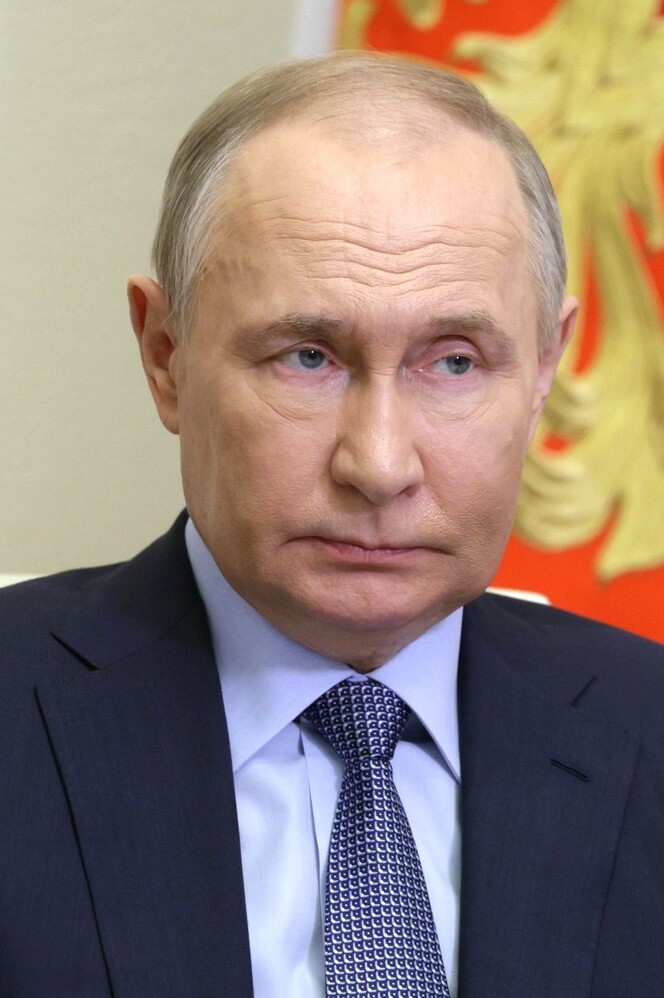
Portrait: Presidential Press and Information Office, kremlin.ru, 17 April 2024, via Wikimedia Commons. CC BY 4.0. Portrait crop supplied by Commons; displayed at reduced size.